
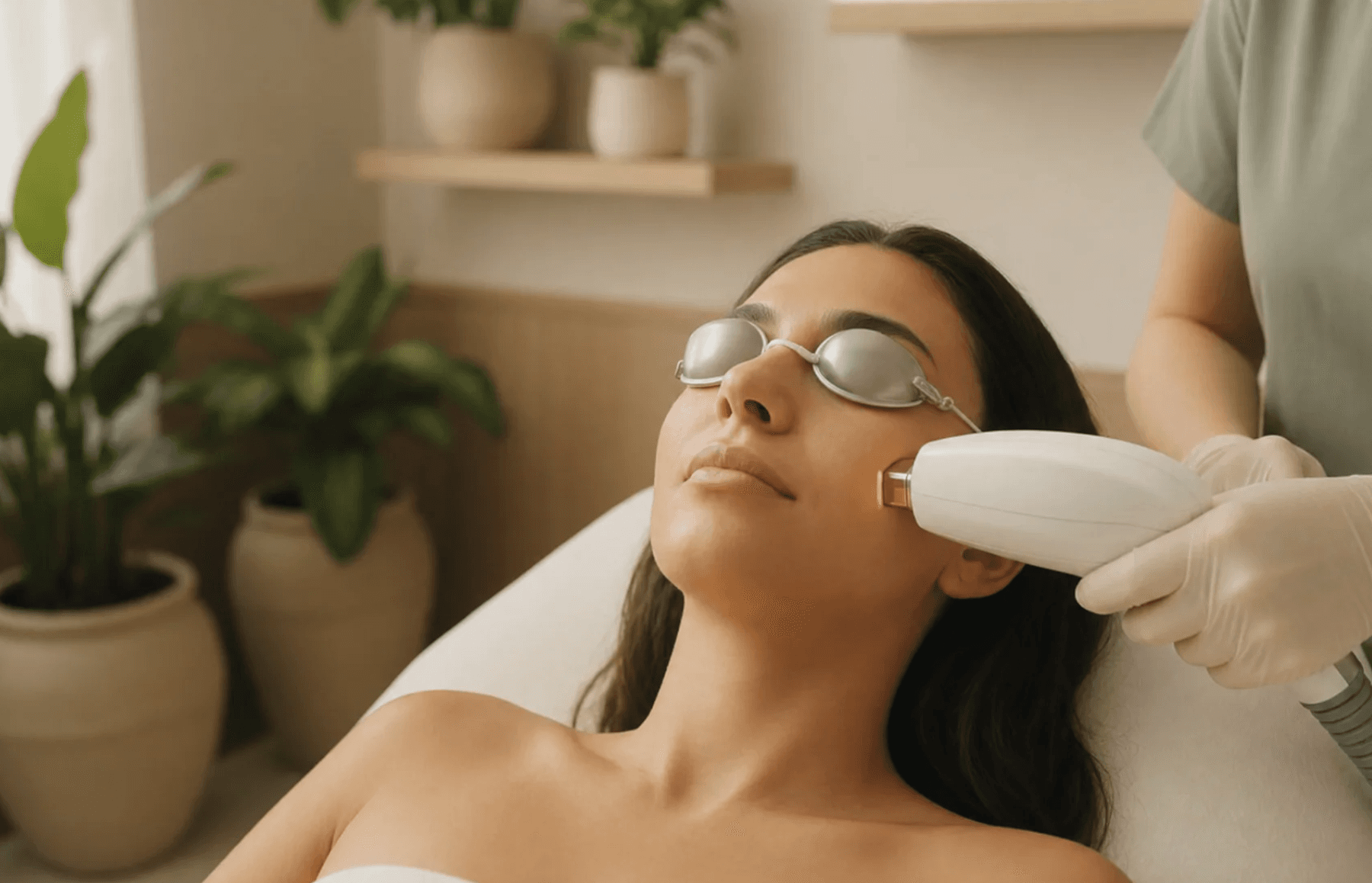
Laser and light treatments sound alike from the outside, but each one is built for a different job. One fades brown spots. Another calms redness. Another reduces unwanted hair, and another firms skin that has started to loosen. The names blur together, which is why people often book the wrong thing first, or put off booking anything at all.
Knowing what each device targets makes the choice much simpler. Here is a plain guide to the laser and light treatments we offer at Nuvera in Raleigh, what each one treats, and what to expect before and after your appointment.
What do laser and light treatments actually do?
Every device sends energy into your skin at a wavelength chosen for a specific target, such as pigment, small blood vessels, or the hair follicle. The skin around that target is largely left alone, which is what makes these treatments so precise compared with anything you can do at home.
Some treatments clear away what you can already see. A brown spot breaks apart so your body can carry it off. A visible vessel fades. Others work deeper and more quietly, prompting your skin to build fresh collagen over the weeks that follow, which is how texture and firmness improve.
That difference matters for your expectations. Treatments that clear visible pigment often show change within days. Treatments that rebuild collagen take weeks or months, and the result is worth the wait.
Which treatment helps with brown spots and sun damage?
An IPL photofacial with the Nordlys system sends pulses of light across the whole treatment area, targeting sun damage, brown spots, redness, and uneven tone at once. It is a strong choice when your main complaint is that your skin looks blotchy overall rather than that one specific spot bothers you.
A session takes about 30 minutes. You may feel a quick warm snap as the light pulses, and dark spots often look darker for several days before they flake away on their own. That darkening is a sign the treatment is working, not a sign something went wrong.
For stubborn discoloration like melasma, pigmentation correction targets excess pigment more directly so your body can clear it. Both approaches work best as a series rather than a single visit, and both depend on daily sunscreen. Sun exposure can undo pigment results faster than almost anything else.
What about redness and visible veins?
Vascular lesion treatment targets the small vessels behind spider veins, facial veins, rosacea, cherry angiomas, and persistent redness. The laser reaches the vessel itself, and your body clears it over the following weeks.
Sessions usually run 15 to 30 minutes depending on the area, with little downtime afterward. You may notice mild redness or slight bruising that fades over a few days, and most people go back to their normal routine the same day.
Mention any medication that affects bleeding or bruising when you book, and plan to stay out of the sun before and after your appointment.
Can lasers improve texture and scars?
Fractional resurfacing uses sublative radiofrequency to create tiny treatment zones across your skin, which prompts the skin between them to repair and renew. It suits acne scars, rough texture, large pores, and stretch marks.
Plan a few low key days afterward. Skin is usually red and feels a little like sandpaper for several days while it heals, so this is not the treatment to book the week of a wedding or a big event.
Scar revision works along similar lines for acne, surgical, and traumatic scars, helping remodel scar tissue so it blends with the skin around it. Scars improve gradually and almost always need a series, so it helps to agree on realistic expectations with your provider at the start rather than judging results after one session.
What can help skin that feels loose?
Sublime radiofrequency skin tightening gently heats the deeper layers of skin to boost your own collagen along the jawline, neck, and decolletage. Sessions run about 30 to 45 minutes and feel warm and comfortable.
It is not a substitute for surgery, and it does not work overnight. Results build gradually as new collagen forms, so you will notice the full effect over the weeks and months after treatment rather than in the mirror that afternoon.
Is laser hair removal safe for every skin type?
With the right device, yes. Our laser hair removal uses the GentleMax Pro Plus, which is safe for all skin types, along with The Gold Standard, our premier hair reduction treatment. Both send quick pulses of light into the follicle to slow and reduce regrowth, with cooling to keep you comfortable.
Small areas take about 15 minutes and larger ones closer to an hour. A full course runs several sessions spaced a few weeks apart, because hair grows in cycles and the laser only reaches the follicles that are actively growing on the day of your visit.
Shave as your provider directs, and skip waxing and plucking between sessions. The laser needs the hair root in place to work, so removing it undercuts the treatment you are paying for.
What does a session actually feel like?
Most people are surprised by how manageable these treatments are. Laser hair removal and IPL feel like a quick snap with a warm sting. Radiofrequency treatments feel like building heat rather than a snap. Numbing options are available where they help.
Sessions are also short. Very few laser and light treatments at Nuvera run longer than an hour, and most land closer to 30 minutes, which makes them easy to fit around a work day.
How many sessions will you need?
It depends on what you are treating. Pigment, redness, and hair reduction almost always call for a series, usually spaced a few weeks apart, with results building from one session to the next.
Collagen treatments work differently. Fewer sessions, more patience. Your provider maps out a realistic schedule at your consultation so you know the time and the cost before you commit to anything.
How should you prepare, and what happens after?
Most laser and light treatments ask for the same few things beforehand. Stay out of the sun, skip tanning and self tanner, and pause retinol and strong exfoliants for a few days. Untanned skin is safer skin to treat, and a fresh tan can mean rescheduling your appointment.
Afterward, sunscreen is not optional. Sun exposure can undo pigment results and bring new spots back, so a broad spectrum SPF 30 or higher every morning protects the work you have already paid for.
Keep the rest of your routine simple for a few days. Gentle cleanser, moisturizer, no scrubbing, and no heavy heat like saunas or hot yoga while your skin settles.
Can you combine treatments?
Often yes, and a good plan usually does. Pigment work pairs well with resurfacing over time, and hair removal runs on its own schedule alongside anything else. If your skin needs a gentler week, Glace pairs microdermabrasion with deep rehydration and has no downtime at all.
What matters is the order and the spacing. Stacking too much too quickly irritates skin and slows progress, so the sequence is part of the plan rather than an afterthought.
How do you choose the right one?
You do not have to sort this out alone. In a consultation, Kelly, our licensed esthetician and laser specialist, looks at your skin, asks what bothers you most, and maps out which treatment, or which order of treatments, makes sense for you.
If you are in the Raleigh area and not sure where to start, book a consultation. There is no pressure, just a clear plan built around your skin and your schedule.